Designing Cards
- Ink Drawing
- Artist Trading Cards
When I was little, I was capricious, especially with toys. At four years old, I was obsessed with stuffed animals like teddy bears. Then, my interest moved from Play-Doh to Legos and so on. As I spent my childhood changing various toys, my mom assumed that I was done with the toys I have stuck with, whenever the previous toys I played left behind. So she used to take them to the donation center.
Probably, she believed the toys were abandoned and had no longer emotional attachment to me. However, I have often remembered my teddy bear covered with my drooling and sweaty smell after I grew up. Whenever I recall it, the moment I feel snuggled with it touches my memory evoking emptiness and loss at the same time.
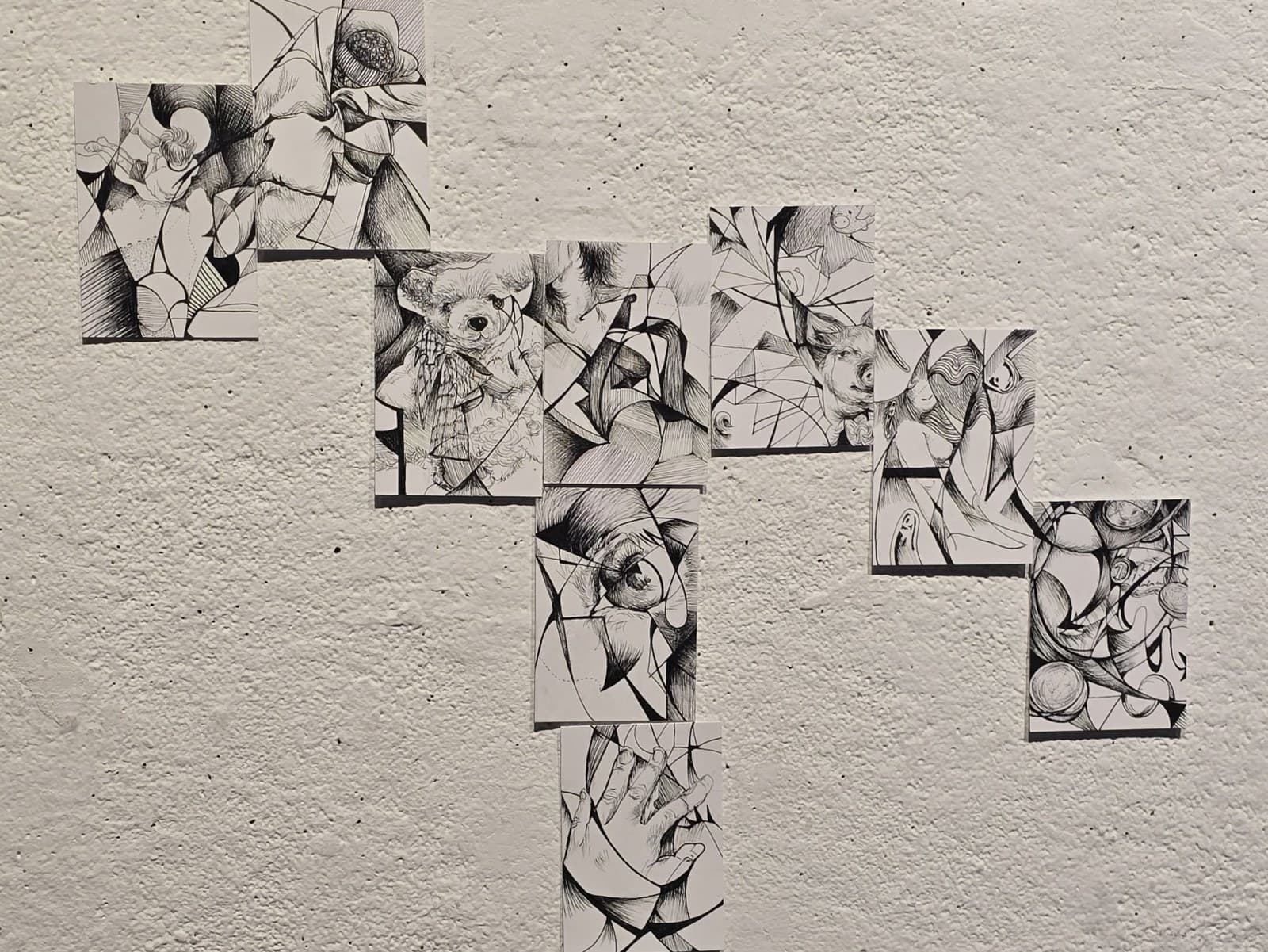
Abandoned. Is the word "abandoned" able to be defined as an action? When I began working on nine artist trading cards, I reflected on the past when my surroundings assumed I abandoned objects and found out they left traces in my mind. Ironically, those traces of the past are alive across time and space vividly. With my own prompt of "abandoned", each card I developed examines different objects left behind, yet they still remain in the fragment of memory with stories: histories, identities and emotions that continue to shape the present even after those objects have been forgotten.
To communicate these ideas I used various sizes of micron ink pens as my drawing tool. Unlike pencil, ink marks are permanent. I can't erase any marks after mark making. So each line and mark becomes a lasting record, just like the abandoned state. By layering fine lines, I was able to build textures and gradations as if abandoned time and space have been stacked. Also, I utilize the concept of "card" as the piece of the memory that connected to my daily life.
For this project, I wanted to experiment with a new kind of art style I never tried before. Rather than drawing in the detailed and realistic style I am used to, I tried to mix my style with Pablo Picasso's cubism and Umberto Boccioni's futurism. Their styles use the geometric lines and shapes in such a way that the object depicted doesn't show itself obviously. I would like to communicate with the viewers about my works in an intriguing way by using geometric formation and mental induction.
Also, I arranged the cards intentionally all together by connecting their lines and shapes between the preceded card and following card. The connection of cards I placed next to each other visualizes the states of abandonment inferring not only the object is left but also continues its own identities through the traces of memory.